[1]:
import os
os.environ['CUDA_VISIBLE_DEVICES'] = '0'
Tutorial B6: Design
ersatz (substitute) + predict + ersatz (substitute) + predict + …
Most of the functions we’ve discussed so far center around extracting what a sequence-based machine learning model has learned after training. Marginalization experiments show the individual effect that each motif has on model predictions; ISM shows the individual effect that each mutation has on model predictions within an observed sequence. However, these models can be used for more than just identifying relevent sequence features and their syntax rules.
For example, trained sequence-based models can be used in the design setting. Although these are numerous methods for designing sequences, each with their own set of important details, the overall approach is to train a model that predicts some sort of readout of interest and then perturb the sequence input until the predicted output matches what is desired by the user. Sometimes, this involves starting with an informative sequence and designing edits, other times this involves the de novo generation of sequences from scratch that exhibit the desired characters. Regardless, the trained model is considered to be an “oracle” that outputs how good the in-progress sequence is.
Greedy Substitution
The most conceptually simple design method is that of greedy substitution. Given an initial sequence, a predictive model, an output goal, and a set of motifs that one could substitute into the sequence, the task is to find which motifs and what exact positioning should be used to achieved a desired output from the predictive model. Because the aim here is to be conceptually simple, the method proceeds across several iterations where at each iteration, every motif is tried at every position in the sequence, and the motif+position pair that yields the largest improvement in terms of getting the model towards its goal. Naturally, this can be very time consuming but is the most straightforward approach.
Let’s start by loading up the Beluga model again.
[2]:
import torch
from model import Beluga

model = Beluga()
model.load_state_dict(torch.load("deepsea.beluga.torch"))
[2]:
<All keys matched successfully>
Let’s see if we can get this model to design a sequence that predicts high AP-1 binding. Yes, this task is unrealistically simple because AP-1 factors bind to a known motif and one could just insert that into the sequence, but it’s a good initial task to show how to use the function.
For the purpose of this example, we can randomly generate a single sequence and use a subset of predefined motifs from JASPAR. Here, we have inserted a motif that we known the Beluga AP-1 tasks respond to as the third motif in the list.
[3]:
import numpy
from tangermeme.utils import random_one_hot

X = random_one_hot((1, 4, 2000), random_state=0).type(torch.float32)
motifs = [
    'GCTAATTAAC',
    'ATGCCCACC',
    "GTGACTCATC",
    'AGAACAGAATGTTCT',
    'TGATGACGTCATCGC',
    'ACATTCCA',
    'GGGAGGAGGGAGAGGAGGAG',
    'TAATCGATTA',
    'CGTCTAGACA',
    'TGCTATTTTTAG',
    'CATTGTTTATTT',
    'TTTCACACCTAGGTGTGAAA',
    'GGCACGCGCC'
]
Next, we need a target that we are trying to get the model to predict with the designed sequence. In this case, we probably want all of the tasks for AP-1 factor proteins (e.g., c-/FOS, c-/JUN, etc). Since the predictions from Beluga are in logit space, we can set it to a relatively high positive value to indicate that we want binding of those specific tasks. Note that the first dimension is 1. Although this method will accept a batch of sequences, the batch size must be 1 because, here,
you are designing a single sequence.
[4]:
names = numpy.loadtxt("beluga_target_names.txt", delimiter=',', dtype=str)
idxs = torch.tensor(['jun' in n.lower() or 'fos' in n.lower() for n in names])

y = torch.zeros(1, 2002)
y[:, idxs] = 3
Now, we can call the function. This function has a similar signature to other tangermeme functions in that it takes in the predictive model, the initial sequence, and a list of motifs. It differs from other functions in that it also takes in y, which is the target that we want the predictive model to output. Optionally, greedy_substitution can take in a mask that is applied to the predictions from the model and the target. Basically, if your model makes predictions for more outputs
than you care about, this mask lets you remove some of those outputs from the loss. In our case, we can remove all predictions not related to the AP-1 factors and say that we want to design a sequence with the highest binding of AP-1 factors regardless of what happens to all other tasks.
[5]:
from tangermeme.design import greedy_substitution

X_hat = greedy_substitution(model, X, y, motifs, output_mask=idxs, max_iter=5, verbose=True)
Iteration 0 -- Loss: 72.97, Improvement: N/A, Idx: N/A, Time (s): 0s
100%|█████████████████████████████████████████████████████████████████████████████████████████████████████████████████████████████████████████████████████████████████████████████████████████████████████████████████████████████████████████| 26/26 [00:17<00:00, 1.45it/s]
Iteration 1 -- Loss: 14.17, Improvement: 58.8, Motif Idx: 17, Pos Idx: 966, Time (s): 17.89
100%|█████████████████████████████████████████████████████████████████████████████████████████████████████████████████████████████████████████████████████████████████████████████████████████████████████████████████████████████████████████| 26/26 [00:18<00:00, 1.38it/s]
Iteration 2 -- Loss: 7.049, Improvement: 7.12, Motif Idx: 15, Pos Idx: 1031, Time (s): 18.81
100%|█████████████████████████████████████████████████████████████████████████████████████████████████████████████████████████████████████████████████████████████████████████████████████████████████████████████████████████████████████████| 26/26 [00:21<00:00, 1.23it/s]
Iteration 3 -- Loss: 4.952, Improvement: 2.098, Motif Idx: 2, Pos Idx: 1068, Time (s): 21.22
100%|█████████████████████████████████████████████████████████████████████████████████████████████████████████████████████████████████████████████████████████████████████████████████████████████████████████████████████████████████████████| 26/26 [00:19<00:00, 1.33it/s]
Iteration 4 -- Loss: 4.222, Improvement: 0.7302, Motif Idx: 10, Pos Idx: 984, Time (s): 19.48
100%|█████████████████████████████████████████████████████████████████████████████████████████████████████████████████████████████████████████████████████████████████████████████████████████████████████████████████████████████████████████| 26/26 [00:18<00:00, 1.42it/s]
Iteration 5 -- Loss: 3.897, Improvement: 0.3251, Motif Idx: 19, Pos Idx: 844, Time (s): 18.26
We can see what is happening during the process from the logs. Iteration 0 is meant to show what the loss looks like before any substitutions are made. We specified that only five rounds should happen, but can also specify that the improvement must be above a certain threshold (tol, default is 1e-3). The process will terminate early if adding in more motifs would cause a higher loss than the previous iteration.
Unsurprisingly, by looking at the motif idx we can see that an AP-1 motif or its reverse complement is chosen in most of the rounds and that these insertions are somewhat close to each other. The middle is the sequence is not necessarily preferentially chosen by the design method, but it is possible that the models being used will prefer motifs to be in the middle of the sequence as an artifact of how they are trained.
We can now take a look at what the predictions from the model look like before and after substituting in these motifs.
[6]:
from matplotlib import pyplot as plt
import seaborn; seaborn.set_style('whitegrid')

from tangermeme.predict import predict

y0 = predict(model, X).numpy(force=True)[0]
y1 = predict(model, X_hat).numpy(force=True)[0]

plt.plot([-9, 5], [-9, 5], c='0.3')
plt.scatter(y0, y1, s=1)
plt.scatter(y0[idxs], y1[idxs], s=2, color='r', label='AP-1 Targets')
plt.legend()
plt.xlabel("Task Logits Before Design")
plt.ylabel("Task Logits After Design")
plt.show()

Not only do we see that the tasks related to AP-1 binding have increased logits, we can see that they seem to be close to the desired value of 3. Interestingly, not all of the AP-1 tasks are increased to that level, and there seems to be quite a bit of a jitter in all of the other tasks.
Greedy Saturation Mutagenesis / Evolutionary Algorithms
Rather than implanting entire motifs into sequences, some approaches consider changing only one nucleotide at a time. This is sometimes done probabilistically, where only a subset of potential mutations are considered, and is sometimes comprehensive, e.g., saturation mutagenesis. Regardless, each approach proceeds similarly to the greedy approach described above: a nucleotide is changed, the change in score is recorded, and the best individual mutation is made at the end of each round.
This approach of only changing a single nucleotide in each round can be performed by simply passing in the four nucleotides as options rather than entire motifs.
[7]:
X_hat = greedy_substitution(model, X, y, ['A', 'C', 'G', 'T'], reverse_complement=False, output_mask=idxs, max_iter=15, verbose=True)
Iteration 0 -- Loss: 72.97, Improvement: N/A, Idx: N/A, Time (s): 0s
100%|███████████████████████████████████████████████████████████████████████████████████████████████████████████████████████████████████████████████████████████████████████████████████████████████████████████████████████████████████████████| 4/4 [00:03<00:00, 1.23it/s]
Iteration 1 -- Loss: 53.46, Improvement: 19.52, Motif Idx: 2, Pos Idx: 1058, Time (s): 3.247
100%|███████████████████████████████████████████████████████████████████████████████████████████████████████████████████████████████████████████████████████████████████████████████████████████████████████████████████████████████████████████| 4/4 [00:03<00:00, 1.30it/s]
Iteration 2 -- Loss: 40.33, Improvement: 13.13, Motif Idx: 2, Pos Idx: 1083, Time (s): 3.084
100%|███████████████████████████████████████████████████████████████████████████████████████████████████████████████████████████████████████████████████████████████████████████████████████████████████████████████████████████████████████████| 4/4 [00:02<00:00, 1.40it/s]
Iteration 3 -- Loss: 32.48, Improvement: 7.845, Motif Idx: 3, Pos Idx: 1087, Time (s): 2.859
100%|███████████████████████████████████████████████████████████████████████████████████████████████████████████████████████████████████████████████████████████████████████████████████████████████████████████████████████████████████████████| 4/4 [00:02<00:00, 1.43it/s]
Iteration 4 -- Loss: 27.84, Improvement: 4.637, Motif Idx: 3, Pos Idx: 1029, Time (s): 2.803
100%|███████████████████████████████████████████████████████████████████████████████████████████████████████████████████████████████████████████████████████████████████████████████████████████████████████████████████████████████████████████| 4/4 [00:03<00:00, 1.33it/s]
Iteration 5 -- Loss: 19.53, Improvement: 8.317, Motif Idx: 0, Pos Idx: 1031, Time (s): 3.008
100%|███████████████████████████████████████████████████████████████████████████████████████████████████████████████████████████████████████████████████████████████████████████████████████████████████████████████████████████████████████████| 4/4 [00:03<00:00, 1.32it/s]
Iteration 6 -- Loss: 13.43, Improvement: 6.095, Motif Idx: 1, Pos Idx: 1028, Time (s): 3.029
100%|███████████████████████████████████████████████████████████████████████████████████████████████████████████████████████████████████████████████████████████████████████████████████████████████████████████████████████████████████████████| 4/4 [00:02<00:00, 1.36it/s]
Iteration 7 -- Loss: 11.12, Improvement: 2.313, Motif Idx: 1, Pos Idx: 1035, Time (s): 2.938
100%|███████████████████████████████████████████████████████████████████████████████████████████████████████████████████████████████████████████████████████████████████████████████████████████████████████████████████████████████████████████| 4/4 [00:03<00:00, 1.24it/s]
Iteration 8 -- Loss: 9.498, Improvement: 1.62, Motif Idx: 3, Pos Idx: 994, Time (s): 3.238
100%|███████████████████████████████████████████████████████████████████████████████████████████████████████████████████████████████████████████████████████████████████████████████████████████████████████████████████████████████████████████| 4/4 [00:03<00:00, 1.29it/s]
Iteration 9 -- Loss: 8.412, Improvement: 1.086, Motif Idx: 0, Pos Idx: 1061, Time (s): 3.1
100%|███████████████████████████████████████████████████████████████████████████████████████████████████████████████████████████████████████████████████████████████████████████████████████████████████████████████████████████████████████████| 4/4 [00:02<00:00, 1.50it/s]
Iteration 10 -- Loss: 7.221, Improvement: 1.192, Motif Idx: 3, Pos Idx: 1062, Time (s): 2.664
100%|███████████████████████████████████████████████████████████████████████████████████████████████████████████████████████████████████████████████████████████████████████████████████████████████████████████████████████████████████████████| 4/4 [00:02<00:00, 1.58it/s]
Iteration 11 -- Loss: 6.564, Improvement: 0.657, Motif Idx: 3, Pos Idx: 1086, Time (s): 2.532
100%|███████████████████████████████████████████████████████████████████████████████████████████████████████████████████████████████████████████████████████████████████████████████████████████████████████████████████████████████████████████| 4/4 [00:02<00:00, 1.79it/s]
Iteration 12 -- Loss: 6.02, Improvement: 0.5434, Motif Idx: 3, Pos Idx: 1071, Time (s): 2.235
100%|███████████████████████████████████████████████████████████████████████████████████████████████████████████████████████████████████████████████████████████████████████████████████████████████████████████████████████████████████████████| 4/4 [00:04<00:00, 1.25s/it]
Iteration 13 -- Loss: 5.359, Improvement: 0.6612, Motif Idx: 1, Pos Idx: 1070, Time (s): 4.983
100%|███████████████████████████████████████████████████████████████████████████████████████████████████████████████████████████████████████████████████████████████████████████████████████████████████████████████████████████████████████████| 4/4 [00:05<00:00, 1.29s/it]
Iteration 14 -- Loss: 4.795, Improvement: 0.5639, Motif Idx: 2, Pos Idx: 1065, Time (s): 5.171
100%|███████████████████████████████████████████████████████████████████████████████████████████████████████████████████████████████████████████████████████████████████████████████████████████████████████████████████████████████████████████| 4/4 [00:02<00:00, 1.59it/s]
Iteration 15 -- Loss: 4.527, Improvement: 0.2686, Motif Idx: 1, Pos Idx: 979, Time (s): 2.511
Each round is much faster because, although you are considering changes at roughly the same number of positions, you are considering a significantly smaller number of “motifs”. However, you will likely need many more iterations because adding in a motif of length 8 will require 8 rounds rather than the single round in the other approach. Something interesting to note is that midway the improvement increases, indicating that an epistatic effect was discovered, i.e., that the inclusion of one or more earlier positions was required before that position could really improve output.
[8]:
y0 = predict(model, X).numpy(force=True)[0]
y1 = predict(model, X_hat).numpy(force=True)[0]

plt.plot([-9, 5], [-9, 5], c='0.3')
plt.scatter(y0, y1, s=1)
plt.scatter(y0[idxs], y1[idxs], s=2, color='r', label='AP-1 Targets')
plt.legend()
plt.xlabel("Task Logits Before Design")
plt.ylabel("Task Logits After Design")
plt.show()
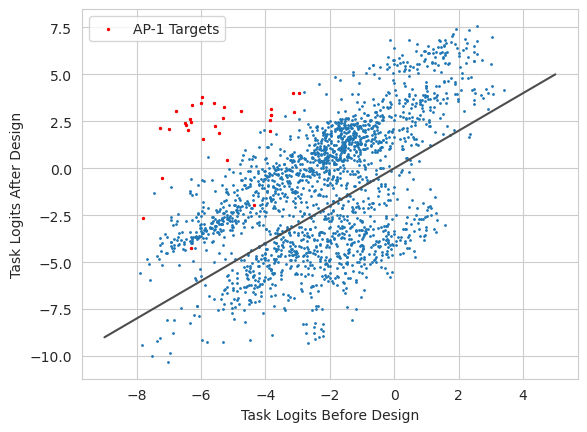
Looks like we are starting to get there, but are not as close as implanting ten entire motifs.
This method has strengths and weaknesses. The weaknesses are that it may take many more iterations to get good results and that it gives potentially too much flexiblility of the model, allowing it to overfit to spurious correlations (e.g., finding a random mutation that is not part of the model but happens to make the model predict closer to the desired output). The strengths are that it does not rely on a set of pre-identified set of motifs and so can make changes that fall outside the set of motifs, e.g., adding in a lower affinity version of a motif or an alternate version of the motif that is actually stronger than the one provided.
Balancing Losses
Is it possible to design a sequence that keeps the other tasks as close to their original values as possible while still increasing the predictions for AP-1 binding? To do this, rather than using a mask to ignore the outputs from non-AP-1 tasks, we will set the target values for that task to the original predictions from the model.
[9]:
y = predict(model, X)
y[:, idxs] = 3

X_hat2 = greedy_substitution(model, X, y, motifs, max_iter=10, verbose=True)
Iteration 0 -- Loss: 1.13, Improvement: N/A, Idx: N/A, Time (s): 0s
100%|█████████████████████████████████████████████████████████████████████████████████████████████████████████████████████████████████████████████████████████████████████████████████████████████████████████████████████████████████████████| 26/26 [00:14<00:00, 1.81it/s]
Iteration 1 -- Loss: 0.6534, Improvement: 0.4765, Motif Idx: 15, Pos Idx: 896, Time (s): 14.37
100%|█████████████████████████████████████████████████████████████████████████████████████████████████████████████████████████████████████████████████████████████████████████████████████████████████████████████████████████████████████████| 26/26 [00:18<00:00, 1.40it/s]
Iteration 2 -- Loss: 0.5999, Improvement: 0.05355, Motif Idx: 2, Pos Idx: 905, Time (s): 18.59
100%|█████████████████████████████████████████████████████████████████████████████████████████████████████████████████████████████████████████████████████████████████████████████████████████████████████████████████████████████████████████| 26/26 [00:11<00:00, 2.27it/s]
Iteration 3 -- Loss: 0.5821, Improvement: 0.01778, Motif Idx: 14, Pos Idx: 1063, Time (s): 11.45
100%|█████████████████████████████████████████████████████████████████████████████████████████████████████████████████████████████████████████████████████████████████████████████████████████████████████████████████████████████████████████| 26/26 [00:14<00:00, 1.77it/s]
Iteration 4 -- Loss: 0.5714, Improvement: 0.01067, Motif Idx: 13, Pos Idx: 852, Time (s): 14.67
100%|█████████████████████████████████████████████████████████████████████████████████████████████████████████████████████████████████████████████████████████████████████████████████████████████████████████████████████████████████████████| 26/26 [00:21<00:00, 1.19it/s]
Iteration 5 -- Loss: 0.5648, Improvement: 0.006629, Motif Idx: 12, Pos Idx: 704, Time (s): 21.86
100%|█████████████████████████████████████████████████████████████████████████████████████████████████████████████████████████████████████████████████████████████████████████████████████████████████████████████████████████████████████████| 26/26 [00:22<00:00, 1.14it/s]
Iteration 6 -- Loss: 0.5588, Improvement: 0.006038, Motif Idx: 23, Pos Idx: 1550, Time (s): 22.89
100%|█████████████████████████████████████████████████████████████████████████████████████████████████████████████████████████████████████████████████████████████████████████████████████████████████████████████████████████████████████████| 26/26 [00:20<00:00, 1.24it/s]
Iteration 7 -- Loss: 0.5535, Improvement: 0.005304, Motif Idx: 3, Pos Idx: 805, Time (s): 20.89
100%|█████████████████████████████████████████████████████████████████████████████████████████████████████████████████████████████████████████████████████████████████████████████████████████████████████████████████████████████████████████| 26/26 [00:20<00:00, 1.30it/s]
Iteration 8 -- Loss: 0.5496, Improvement: 0.003878, Motif Idx: 12, Pos Idx: 1193, Time (s): 20.01
100%|█████████████████████████████████████████████████████████████████████████████████████████████████████████████████████████████████████████████████████████████████████████████████████████████████████████████████████████████████████████| 26/26 [00:19<00:00, 1.34it/s]
Iteration 9 -- Loss: 0.5465, Improvement: 0.003076, Motif Idx: 5, Pos Idx: 1588, Time (s): 19.47
100%|█████████████████████████████████████████████████████████████████████████████████████████████████████████████████████████████████████████████████████████████████████████████████████████████████████████████████████████████████████████| 26/26 [00:19<00:00, 1.34it/s]
Iteration 10 -- Loss: 0.5449, Improvement: 0.001644, Motif Idx: 11, Pos Idx: 1803, Time (s): 19.46
Unsurprisingly, we can see that the magnitude of the loss goes down because we are now averaging over two orders of magnitude more tasks. Interestingly, after picking the AP-1 motif and its reverse complement (motif indices 2 and 15) in the first two rounds, the method switches to a variety of other motifs rather than continuing to stack strong AP-1 sites. When every task counts, piling on more strong AP-1 binding would push the other tasks too far from their original values. Additionally, it looks like the motifs are placed in the sequence further apart than they were in the other example.
[10]:
y0 = predict(model, X).numpy(force=True)[0]
y1 = predict(model, X_hat2).numpy(force=True)[0]

plt.plot([-9, 5], [-9, 5], c='0.3')
plt.scatter(y0, y1, s=1)
plt.scatter(y0[idxs], y1[idxs], s=2, color='r', label='AP-1 Targets')
plt.legend()
plt.xlabel("Task Logits Before Design")
plt.ylabel("Task Logits After Design")
plt.show()
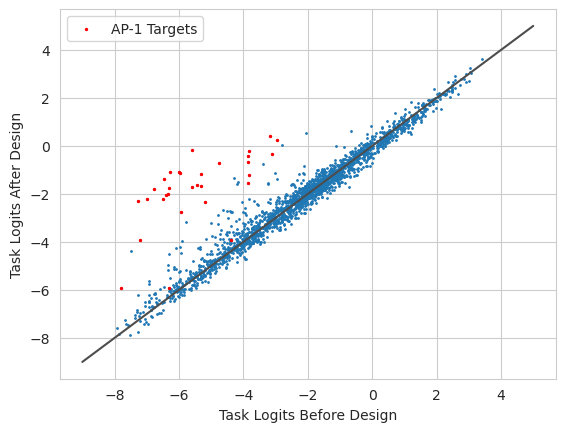
And it seems like we’ve reached a new compromise! The AP-1 related tasks are nicely separated from the other tasks (except for two of them) and, although they do not reach the desired objective value of 3, the flip side is that the other tasks seem to be much closer to their original values.
Input Masks
Sometimes, we may not want to consider substitutions at every position in the sequence. Perhaps we know that the most important part of the sequence is in the middle, or have known motifs in our sequence that we want to protect, or maybe we just do not need to be as precise as considering any possible possible. Regardless of the reason for having a mask, using one can speed up design significantly.
Normally, the input to the model is 2000 bp. What happens if we only use the middle 200 bp for design?
[11]:
y = predict(model, X)
y[:, idxs] = 3

input_mask = torch.zeros(2000, dtype=bool)
input_mask[900:1100] = True

X_hat2 = greedy_substitution(model, X, y, motifs, max_iter=5, input_mask=input_mask, verbose=True)
Iteration 0 -- Loss: 1.13, Improvement: N/A, Idx: N/A, Time (s): 0s
100%|█████████████████████████████████████████████████████████████████████████████████████████████████████████████████████████████████████████████████████████████████████████████████████████████████████████████████████████████████████████| 26/26 [00:06<00:00, 4.08it/s]
Iteration 1 -- Loss: 0.6572, Improvement: 0.4728, Motif Idx: 2, Pos Idx: 904, Time (s): 6.381
100%|█████████████████████████████████████████████████████████████████████████████████████████████████████████████████████████████████████████████████████████████████████████████████████████████████████████████████████████████████████████| 26/26 [00:06<00:00, 3.81it/s]
Iteration 2 -- Loss: 0.6223, Improvement: 0.03489, Motif Idx: 15, Pos Idx: 1099, Time (s): 6.82
100%|█████████████████████████████████████████████████████████████████████████████████████████████████████████████████████████████████████████████████████████████████████████████████████████████████████████████████████████████████████████| 26/26 [00:07<00:00, 3.65it/s]
Iteration 3 -- Loss: 0.5964, Improvement: 0.02594, Motif Idx: 1, Pos Idx: 999, Time (s): 7.116
100%|█████████████████████████████████████████████████████████████████████████████████████████████████████████████████████████████████████████████████████████████████████████████████████████████████████████████████████████████████████████| 26/26 [00:06<00:00, 4.20it/s]
Iteration 4 -- Loss: 0.5873, Improvement: 0.009092, Motif Idx: 5, Pos Idx: 922, Time (s): 6.186
100%|█████████████████████████████████████████████████████████████████████████████████████████████████████████████████████████████████████████████████████████████████████████████████████████████████████████████████████████████████████████| 26/26 [00:06<00:00, 3.87it/s]
Iteration 5 -- Loss: 0.5821, Improvement: 0.005156, Motif Idx: 8, Pos Idx: 945, Time (s): 6.72
As you might expect, we see a clear speed improvement when only considering one tenth of the positions – each round now evaluates roughly a tenth as many substitutions. That makes sense. But how do the results look?
[12]:
y0 = predict(model, X).numpy(force=True)[0]
y1 = predict(model, X_hat2).numpy(force=True)[0]

plt.plot([-9, 5], [-9, 5], c='0.3')
plt.scatter(y0, y1, s=1)
plt.scatter(y0[idxs], y1[idxs], s=2, color='r', label='AP-1 Targets')
plt.legend()
plt.xlabel("Task Logits Before Design")
plt.ylabel("Task Logits After Design")
plt.show()
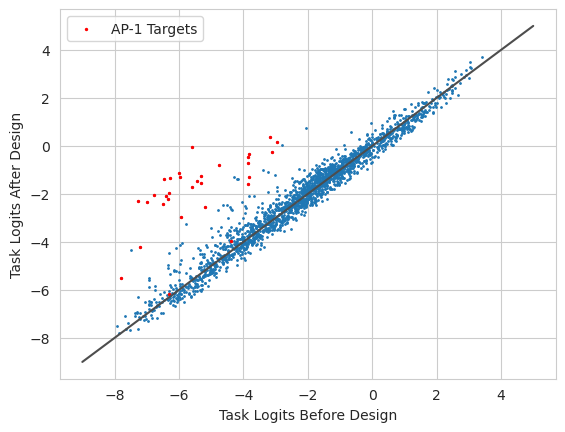
The results look quite similar to before. However, this is likely because the original sequence we used was completely randomly generated and the improvements are likely coming from simply adding AP-1 motifs nearby to each other, so limiting the possible space isn’t a huge constraint. In settings with actual structured sequences as input or where running more iterations to get the maximum possible improvement is necessary, having more sequence can be helpful.
Loss Functions
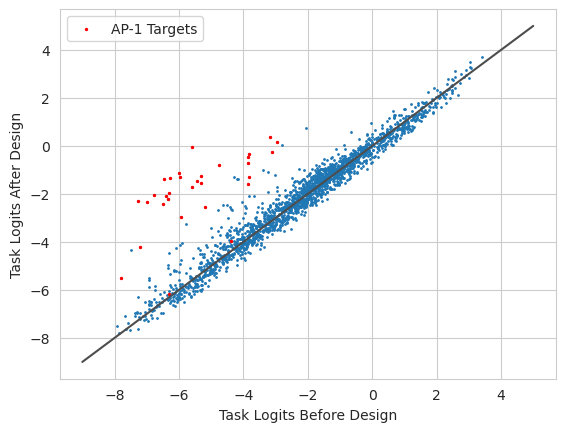
By default, the loss used is torch.nn.MSELoss without reduction because it is a reasonable and general-purpose loss. However, you can use whatever loss you’d like by passing the loss function into loss=.... This can be any loss implemented in PyTorch that is reasonable for your model or any custom function with the signature def loss(y, y_hat) with y.shape == (n, ...) that returns a tensor with size (n, ...). Basically, every example that gets passed into the loss function
needs to have one or more losses associated with it. Everything except for the first dimension gets averaged such that you get one value per example. This is a critical detail because, by default, PyTorch losses will average over the batch dimension as well and only give you a single number regardless of the number of examples passed in. The design function needs to know the example with the minimal loss and so any function – custom or not – needs to return the loss for each example.
To demonstrate, let’s do the design but use a different loss function.
[13]:
y = predict(model, X)
y[:, idxs] = 3

X_hat3 = greedy_substitution(model, X, y, motifs, max_iter=3, loss=torch.nn.HuberLoss(reduction='none'), verbose=True)
Iteration 0 -- Loss: 0.1229, Improvement: N/A, Idx: N/A, Time (s): 0s
100%|█████████████████████████████████████████████████████████████████████████████████████████████████████████████████████████████████████████████████████████████████████████████████████████████████████████████████████████████████████████| 26/26 [00:19<00:00, 1.33it/s]
Iteration 1 -- Loss: 0.1188, Improvement: 0.004087, Motif Idx: 5, Pos Idx: 910, Time (s): 19.55
100%|█████████████████████████████████████████████████████████████████████████████████████████████████████████████████████████████████████████████████████████████████████████████████████████████████████████████████████████████████████████| 26/26 [00:18<00:00, 1.41it/s]
Iteration 2 -- Loss: 0.1185, Improvement: 0.0003168, Motif Idx: 14, Pos Idx: 692, Time (s): 18.46
[14]:
y0 = predict(model, X).numpy(force=True)[0]
y1 = predict(model, X_hat2).numpy(force=True)[0]

plt.plot([-9, 5], [-9, 5], c='0.3')
plt.scatter(y0, y1, s=1)
plt.scatter(y0[idxs], y1[idxs], s=2, color='r', label='AP-1 Targets')
plt.legend()
plt.xlabel("Task Logits Before Design")
plt.ylabel("Task Logits After Design")
plt.show()
Elimination of Motifs
An important part of this greedy procedure is that it does not only involve inserting new motifs into uninformative sequence, but that it will eliminate motifs that yield activity that the model does not want. As an illustration, let’s consider the simple case where a motif drives unwanted AP-1 binding activity and the goal is to design a sequence that does not exhibit AP-1 binding.
Here, we will start with a sequence that has the AP-1 motif in it already.
[15]:
from tangermeme.ersatz import substitute

X = random_one_hot((1, 4, 2000), random_state=0).type(torch.float32)
X = substitute(X, "GTGACTCATC")
Now, we will specify that we want baseline levels of AP-1 binding while preserving everything else.
[16]:
y = predict(model, X)
y[:, idxs] = -5

X_hat3 = greedy_substitution(model, X, y, motifs, max_iter=1, verbose=True)
Iteration 0 -- Loss: 0.1575, Improvement: N/A, Idx: N/A, Time (s): 0s
100%|█████████████████████████████████████████████████████████████████████████████████████████████████████████████████████████████████████████████████████████████████████████████████████████████████████████████████████████████████████████| 26/26 [00:19<00:00, 1.30it/s]
Iteration 1 -- Loss: 0.1182, Improvement: 0.03929, Motif Idx: 25, Pos Idx: 986, Time (s): 19.96
It looks like the process figured out that it should substitute in a motif that the model does not respond to (the reverse complement of GGCACGCGCC, motif index 25) right in the middle of the sequence, where our AP-1 motif is, to eliminate it. Keep in mind that the process did not need to be told to eliminate motifs, or what motifs are uninformative. By being a comprehensive process, it can figure out both of these things in a data-driven manner. Further, the process can interleave the
adding and eliminating of motifs – it is not a “one or the other” situation. If some motifs need to be eliminated, and others need to be added, this procedure can figure that out (subject to the limitations of it being a greedy algorithm).
[17]:
y0 = predict(model, X).numpy(force=True)[0]
y1 = predict(model, X_hat3).numpy(force=True)[0]

plt.plot([-9, 5], [-9, 5], c='0.3')
plt.scatter(y0, y1, s=1)
plt.scatter(y0[idxs], y1[idxs], s=2, color='r', label='AP-1 Targets')
plt.legend()
plt.xlabel("Task Logits Before Design")
plt.ylabel("Task Logits After Design")
plt.show()
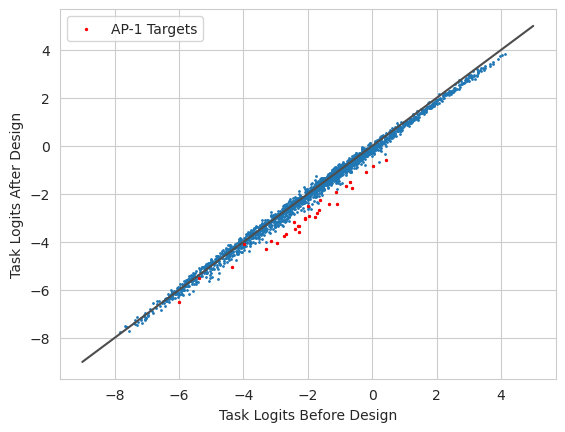
And it looks like the predicted signal is lower after the elimination of the motif!
We can do a more targetted approach by using the greedy saturated mutagenesis approach.
[18]:
X_hat3 = greedy_substitution(model, X, y, ['A', 'C', 'G', 'T'], reverse_complement=False, max_iter=1, verbose=True)

y0 = predict(model, X).numpy(force=True)[0]
y1 = predict(model, X_hat3).numpy(force=True)[0]

plt.plot([-9, 5], [-9, 5], c='0.3')
plt.scatter(y0, y1, s=1)
plt.scatter(y0[idxs], y1[idxs], s=2, color='r', label='AP-1 Targets')
plt.legend()
plt.xlabel("Task Logits Before Design")
plt.ylabel("Task Logits After Design")
plt.show()
Iteration 0 -- Loss: 0.1575, Improvement: N/A, Idx: N/A, Time (s): 0s
100%|███████████████████████████████████████████████████████████████████████████████████████████████████████████████████████████████████████████████████████████████████████████████████████████████████████████████████████████████████████████| 4/4 [00:02<00:00, 1.83it/s]
Iteration 1 -- Loss: 0.1186, Improvement: 0.03883, Motif Idx: 3, Pos Idx: 995, Time (s): 2.194
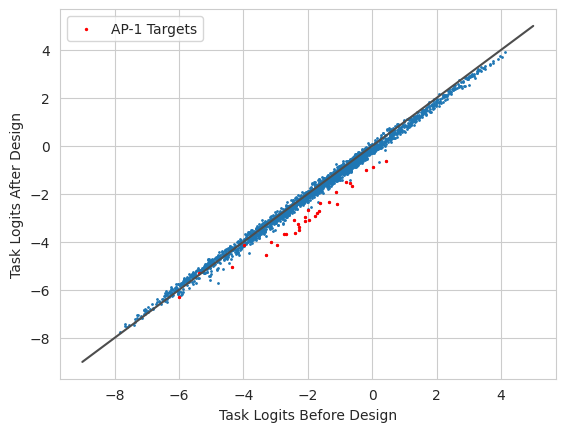
With only a single mutation knocking out a key position in the motif, we are able to achieve similar results.
Half Precision
A strength of this prediction-based design is that it is fairly robust to operating at lower precision because we are simply looking for the best motif and position, rather than needing a very precise value, and if two choices happen to be similar and swapped at lower precision the consequences for design are minimal.
[19]:
y = torch.zeros(1, 2002)
y[:, idxs] = 3

print("Full Precision")
X_hat = greedy_substitution(model.float(), X.float(), y.float(), motifs, output_mask=idxs, max_iter=3, verbose=True)

print("\nHalf Precision")
X_hat = greedy_substitution(model.half(), X.half(), y.half(), motifs, output_mask=idxs, max_iter=3, verbose=True)
Full Precision
Iteration 0 -- Loss: 28.48, Improvement: N/A, Idx: N/A, Time (s): 0s
100%|█████████████████████████████████████████████████████████████████████████████████████████████████████████████████████████████████████████████████████████████████████████████████████████████████████████████████████████████████████████| 26/26 [00:19<00:00, 1.34it/s]
Iteration 1 -- Loss: 7.545, Improvement: 20.93, Motif Idx: 15, Pos Idx: 979, Time (s): 19.44
100%|█████████████████████████████████████████████████████████████████████████████████████████████████████████████████████████████████████████████████████████████████████████████████████████████████████████████████████████████████████████| 26/26 [00:19<00:00, 1.35it/s]
Iteration 2 -- Loss: 4.787, Improvement: 2.759, Motif Idx: 15, Pos Idx: 1014, Time (s): 19.21
100%|█████████████████████████████████████████████████████████████████████████████████████████████████████████████████████████████████████████████████████████████████████████████████████████████████████████████████████████████████████████| 26/26 [00:19<00:00, 1.36it/s]
Iteration 3 -- Loss: 4.135, Improvement: 0.6518, Motif Idx: 22, Pos Idx: 1040, Time (s): 19.15

Half Precision
Iteration 0 -- Loss: 28.47, Improvement: N/A, Idx: N/A, Time (s): 0s
100%|█████████████████████████████████████████████████████████████████████████████████████████████████████████████████████████████████████████████████████████████████████████████████████████████████████████████████████████████████████████| 26/26 [00:16<00:00, 1.59it/s]
Iteration 1 -- Loss: 7.543, Improvement: 20.92, Motif Idx: 15, Pos Idx: 979, Time (s): 16.34
100%|█████████████████████████████████████████████████████████████████████████████████████████████████████████████████████████████████████████████████████████████████████████████████████████████████████████████████████████████████████████| 26/26 [00:18<00:00, 1.40it/s]
Iteration 2 -- Loss: 4.789, Improvement: 2.754, Motif Idx: 15, Pos Idx: 1014, Time (s): 18.59
100%|█████████████████████████████████████████████████████████████████████████████████████████████████████████████████████████████████████████████████████████████████████████████████████████████████████████████████████████████████████████| 26/26 [00:17<00:00, 1.45it/s]
Iteration 3 -- Loss: 4.137, Improvement: 0.6523, Motif Idx: 22, Pos Idx: 1040, Time (s): 17.92
Looks like we are getting the same motifs inserted at the same positions, but with a nice speed boost. Using half precision also potentially enables one to use a bigger batch size, which can be helpful for the modern GPUs that might be underutilized.
Beam Search
Every design above used greedy_substitution, which commits to the single best edit each round. beam_substitution generalizes this: each round it keeps the beam_size lowest-loss complete sequences (the “beam”) and expands all of them, rather than keeping only the single best edit. Because each step substitutes a motif into an existing sequence rather than growing one, every candidate is always a full-length sequence – there is no need to score partial sequences, and the search is
over trajectories through edit-space rather than positions in a growing string.
Setting beam_size=1 recovers greedy_substitution exactly. Larger beams hedge across several trajectories, which can recover good multi-edit combinations that the greedy search prunes away after a locally-suboptimal first edit, at a cost that scales roughly linearly with beam_size. Below we run the same AP-1 design task with a beam of five and compare it against the greedy result for the same number of iterations.
[20]:
from tangermeme.design import beam_substitution

X = random_one_hot((1, 4, 2000), random_state=0).type(torch.float32)
y = torch.zeros(1, 2002)
y[:, idxs] = 3

X_hat_greedy = greedy_substitution(model, X, y, motifs, output_mask=idxs, max_iter=5)
X_hat_beam = beam_substitution(model, X, y, motifs, output_mask=idxs, beam_size=5, max_iter=5, verbose=True)
Iteration 0 -- Loss: 72.96, Improvement: N/A, Idx: N/A, Time (s): 0s
100%|█████████████████████████████████████████████████████████████████████████████████████████████████████████████████████████████████████████████████████████████████████████████████████████████████████████████████████████████████████████| 26/26 [00:18<00:00, 1.39it/s]
Iteration 1 -- Loss: 14.17, Improvement: 58.79, Beam: 5, Time (s): 18.66
100%|█████████████████████████████████████████████████████████████████████████████████████████████████████████████████████████████████████████████████████████████████████████████████████████████████████████████████████████████████████████| 26/26 [00:14<00:00,  1.86it/s]
100%|█████████████████████████████████████████████████████████████████████████████████████████████████████████████████████████████████████████████████████████████████████████████████████████████████████████████████████████████████████████| 26/26 [00:10<00:00,  2.36it/s]
100%|█████████████████████████████████████████████████████████████████████████████████████████████████████████████████████████████████████████████████████████████████████████████████████████████████████████████████████████████████████████| 26/26 [00:13<00:00,  1.90it/s]
100%|█████████████████████████████████████████████████████████████████████████████████████████████████████████████████████████████████████████████████████████████████████████████████████████████████████████████████████████████████████████| 26/26 [00:10<00:00,  2.37it/s]
100%|█████████████████████████████████████████████████████████████████████████████████████████████████████████████████████████████████████████████████████████████████████████████████████████████████████████████████████████████████████████| 26/26 [00:11<00:00,  2.25it/s]
Iteration 2 -- Loss: 6.817, Improvement: 7.353, Beam: 5, Time (s): 61.3
100%|█████████████████████████████████████████████████████████████████████████████████████████████████████████████████████████████████████████████████████████████████████████████████████████████████████████████████████████████████████████| 26/26 [00:10<00:00,  2.49it/s]
100%|█████████████████████████████████████████████████████████████████████████████████████████████████████████████████████████████████████████████████████████████████████████████████████████████████████████████████████████████████████████| 26/26 [00:20<00:00,  1.24it/s]
100%|█████████████████████████████████████████████████████████████████████████████████████████████████████████████████████████████████████████████████████████████████████████████████████████████████████████████████████████████████████████| 26/26 [00:20<00:00,  1.29it/s]
100%|█████████████████████████████████████████████████████████████████████████████████████████████████████████████████████████████████████████████████████████████████████████████████████████████████████████████████████████████████████████| 26/26 [00:20<00:00,  1.26it/s]
100%|█████████████████████████████████████████████████████████████████████████████████████████████████████████████████████████████████████████████████████████████████████████████████████████████████████████████████████████████████████████| 26/26 [00:23<00:00,  1.09it/s]
Iteration 3 -- Loss: 4.735, Improvement: 2.082, Beam: 5, Time (s): 95.91
100%|█████████████████████████████████████████████████████████████████████████████████████████████████████████████████████████████████████████████████████████████████████████████████████████████████████████████████████████████████████████| 26/26 [00:24<00:00,  1.04it/s]
100%|█████████████████████████████████████████████████████████████████████████████████████████████████████████████████████████████████████████████████████████████████████████████████████████████████████████████████████████████████████████| 26/26 [00:23<00:00,  1.10it/s]
100%|█████████████████████████████████████████████████████████████████████████████████████████████████████████████████████████████████████████████████████████████████████████████████████████████████████████████████████████████████████████| 26/26 [00:21<00:00,  1.19it/s]
100%|█████████████████████████████████████████████████████████████████████████████████████████████████████████████████████████████████████████████████████████████████████████████████████████████████████████████████████████████████████████| 26/26 [00:17<00:00,  1.48it/s]
100%|█████████████████████████████████████████████████████████████████████████████████████████████████████████████████████████████████████████████████████████████████████████████████████████████████████████████████████████████████████████| 26/26 [00:27<00:00,  1.06s/it]
Iteration 4 -- Loss: 4.1, Improvement: 0.6345, Beam: 5, Time (s): 115.8
100%|█████████████████████████████████████████████████████████████████████████████████████████████████████████████████████████████████████████████████████████████████████████████████████████████████████████████████████████████████████████| 26/26 [00:22<00:00,  1.14it/s]
100%|█████████████████████████████████████████████████████████████████████████████████████████████████████████████████████████████████████████████████████████████████████████████████████████████████████████████████████████████████████████| 26/26 [00:26<00:00,  1.04s/it]
100%|█████████████████████████████████████████████████████████████████████████████████████████████████████████████████████████████████████████████████████████████████████████████████████████████████████████████████████████████████████████| 26/26 [00:17<00:00,  1.48it/s]
100%|█████████████████████████████████████████████████████████████████████████████████████████████████████████████████████████████████████████████████████████████████████████████████████████████████████████████████████████████████████████| 26/26 [00:16<00:00,  1.53it/s]
100%|█████████████████████████████████████████████████████████████████████████████████████████████████████████████████████████████████████████████████████████████████████████████████████████████████████████████████████████████████████████| 26/26 [00:17<00:00,  1.49it/s]
Iteration 5 -- Loss: 3.736, Improvement: 0.3644, Beam: 5, Time (s): 101.7
The beam search log reports the loss of the best beam member each round. Because the beam retains several candidate sequences instead of one, it can explore motif combinations that greedy would have discarded. Let’s compare how close each design gets the AP-1 tasks to the target logit of 3.
[21]:
y0 = predict(model, X).numpy(force=True)[0]
y_greedy = predict(model, X_hat_greedy).numpy(force=True)[0]
y_beam = predict(model, X_hat_beam).numpy(force=True)[0]

idxs_ = idxs.numpy(force=True)
print("Mean AP-1 logit (target 3.0)")
print("  original: {:.3f}".format(y0[idxs_].mean()))
print("  greedy:   {:.3f}".format(y_greedy[idxs_].mean()))
print("  beam (5): {:.3f}".format(y_beam[idxs_].mean()))
Mean AP-1 logit (target 3.0)
  original: -5.438
  greedy:   2.199
  beam (5): 2.297
Designing Constructs
An alternate view of design is that, rather than designing individual sequences, you want to design a construct with desired changes in model predictions on average when included in a sequence. Basically, rather than ending up with a single sequence where the design may have picked up on specific properties or other motifs already present, you want to design a small construct (of variable width) that can be included in other sequences to induce desired properties. This perspective is similar to the idea of de novo motif discovery, where one wants to find repeating patterns that on average are picked up on by the statistical or machine learning model.
This method works by using repeated marginalizations for design. First, each individual motif is implanted into the middle of a set of background sequences and the one that pushes model predictions in the right direction the most is kept. Then, each motif is considered at each position from a provided max_spacing to the left of the left-most part of the motif to that same distance to the right. To be clear, when a max_spacing of 4 is provided, there will be a maximum of 4 positions
between the right-most of the newly inserted motif and the left-most of the previous left flank, and likewise at the end. Because all positions in this span are considered, motifs can be implanted on top of each other to attenuate their effect. At the end of this process, you will end up with a construct that, on average, pushes model predictions by the amount provided as y. This is in contrast to the greedy_substitution method which will end up with a sequence where the total model
predictions are y.
On average, this function is roughly the same speed as the greedy_substitution function because, while it does not consider all positions in the sequence, it performs an in silico marginalization at each step over the number of provided background sequences.
We can do this with a very similar function call. Remember here that X is a set of background sequences, not a single sequence to optimize, and that y is how much including this construct pushes model predictions, not the actual predictions of the model. Put another way, y is f(X + construct) - f(X), not f(X + construct).
[22]:
from tangermeme.design import greedy_marginalize

y = torch.zeros(1, 2002)
y[:, idxs] = 1

X = random_one_hot((20, 4, 2000), random_state=0).float()
X_hat4 = greedy_marginalize(model, X, y, motifs, output_mask=idxs, max_iter=20, verbose=True)
X_hat4.shape
Iteration 0 -- Loss: 1.0, Improvement: N/A, Idx: N/A, Time (s): 0s
100%|█████████████████████████████████████████████████████████████████████████████████████████████████████████████████████████████████████████████████████████████████████████████████████████████████████████████████████████████████████████| 26/26 [00:02<00:00, 8.75it/s]
Iteration 1 -- Loss: 0.8709, Improvement: 0.1291, Motif Idx: 23, Pos Idx: 999, Time (s): 2.972
100%|█████████████████████████████████████████████████████████████████████████████████████████████████████████████████████████████████████████████████████████████████████████████████████████████████████████████████████████████████████████| 26/26 [02:44<00:00, 6.34s/it]
Iteration 2 -- Loss: 0.4477, Improvement: 0.4233, Motif Idx: 25, Pos Idx: 983, Time (s): 164.9
100%|█████████████████████████████████████████████████████████████████████████████████████████████████████████████████████████████████████████████████████████████████████████████████████████████████████████████████████████████████████████| 26/26 [03:52<00:00, 8.96s/it]
Iteration 3 -- Loss: 0.3145, Improvement: 0.1331, Motif Idx: 22, Pos Idx: 997, Time (s): 233.0
100%|█████████████████████████████████████████████████████████████████████████████████████████████████████████████████████████████████████████████████████████████████████████████████████████████████████████████████████████████████████████| 26/26 [03:31<00:00, 8.12s/it]
Iteration 4 -- Loss: 0.2479, Improvement: 0.06659, Motif Idx: 25, Pos Idx: 1007, Time (s): 211.2
100%|█████████████████████████████████████████████████████████████████████████████████████████████████████████████████████████████████████████████████████████████████████████████████████████████████████████████████████████████████████████| 26/26 [03:40<00:00, 8.50s/it]
Iteration 5 -- Loss: 0.1982, Improvement: 0.04979, Motif Idx: 8, Pos Idx: 1024, Time (s): 220.9
100%|█████████████████████████████████████████████████████████████████████████████████████████████████████████████████████████████████████████████████████████████████████████████████████████████████████████████████████████████████████████| 26/26 [04:33<00:00, 10.51s/it]
[22]:
torch.Size([4, 51])
A one-hot encoding is returned from this function, so we can take a look at what was designed using the characters function which is the conceptual opposite of a one-hot encoding.
[23]:
from tangermeme.utils import characters

characters(X_hat4, allow_N=True)
[23]:
'GGCGCGTGCCNNNNCTAAAAATAGGGCGCGTGCCNNNNNNNCGTCTAGACA'
Interestingly, adding in a single AP-1 motif would increase predictions by significantly more than the desired value of 1. Instead, the method constructs weaker versions of the binding sites by overlapping motifs.
[24]:
from tangermeme.marginalize import marginalize

y_before, y_after = marginalize(model, X, X_hat4.unsqueeze(0))
(y_after - y_before)[:, idxs].mean()
[24]:
tensor(0.9614, dtype=torch.float16)
Final Words
Design can be a tricky process with many tradeoffs, particularly when it comes to genomics. One may need multiple iterations and trying out several strategies before converging on one that yields consistently good edits. This is, in part, because we have not yet fully converged on language for describing the pros and cons of various design methods. It is my hope that packages like tangermeme, and the design methods implemented here, can help move the field forward by standardizing some of
the language we use to describe the design process.